Am I Too Concentrated?
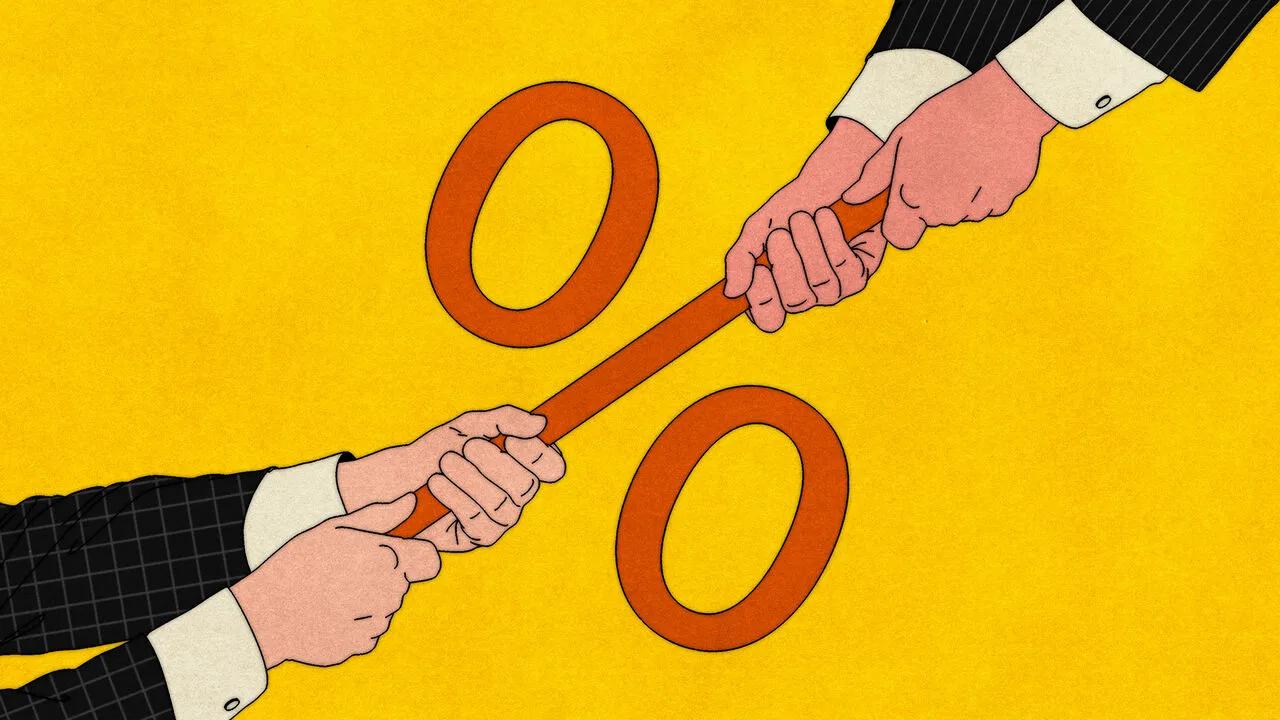
Your company stock made you money. Somewhere along the way it became most of your money. Nobody warned you about that part.
An engineer I know did the math on a Sunday night. Four years at the same company, sixteen quarterly vests, none of them sold. She opened a spreadsheet and added up the brokerage account, the 401(k), and the shares that hadn't vested yet.
One ticker was 58% of everything she owned.
She didn't pick that number. Nobody picks that number. It accumulates while you're busy doing your actual job, one vest at a time, each one too small to feel like a decision.
That's the strange thing about concentration. Almost nobody chooses it. It happens to you, quietly, on a schedule HR set up years ago.
Nobody decides to concentrate
The usual path looks like this. You join a company and they grant you RSUs. The stock does well, which is great, and also means every new vest lands at a higher price. You don't sell, because selling feels like a bet against your own team, or because of taxes, or because you're busy and the default is to do nothing.
Four years later the default has compounded into a position.
If you work in tech, the problem doubles in a way that's easy to miss: your paycheck and your portfolio now depend on the same company. The same bad quarter that dents your shares can dent your job. Economists call this correlated risk. Employees at Enron learned the plain-English version. At the end of 2000, about 62% of Enron's 401(k) assets sat in Enron stock, according to the Employee Benefit Research Institute, and a year later both the jobs and the shares were gone.
Enron is the extreme case, sure. But the structure of the risk is identical at every company. Only the ending differs.
The math nobody shows you at the all-hands
Individual stocks fail more often than it feels like they should.
J.P. Morgan's research team studied every stock in the Russell 3000 going back to 1980. Roughly 40% of them suffered a decline of 70% or more from their peak and never recovered. Not dipped and bounced back, never recovered. About two thirds of all stocks underperformed the index over their lifetime.
Hendrik Bessembinder, a finance professor at Arizona State, went further back. Since 1926, just 4% of stocks account for all of the net wealth the US stock market has ever created. The other 96%, taken together, matched Treasury bills.
Your company stock made you money, so it feels like one of the winners. Maybe it is. But every employee at every company that later cratered felt the same way, for the same reason, and the feeling didn't protect any of them.
Concentration isn't a sin
I'll defend your position for a moment, though, because the standard advice treats concentration like a moral failing. It isn't.
Concentration is how the money got made. Owning a lot of one thing that went up is the entire reason there's something to protect. As the old line goes: concentration makes you rich, diversification keeps you rich. William Bernstein, the investor and author, puts the second half even more bluntly: "If you've won the game, stop playing."
So you didn't do anything wrong. The question is which game you're playing now. Getting rich and staying rich are different games with different rules, and the switch between them doesn't announce itself. There's no email that says your position crossed the line from engine to liability. You have to notice on your own.
So what counts as "too" concentrated?
The honest answer: it depends, and anyone who gives you a single number for every situation is selling something.
But the working ranges are less mysterious than people think. A common rule of thumb among advisors is to keep any single stock under 10% of your investable assets, and some say 5%. Almost nobody who does this for a living says 25% is fine. I've never met anyone credible who'd bless 58%.
Where you sit inside that range depends on your situation. If your income comes from the same company as the stock, your true exposure is bigger than your portfolio shows, so the tolerable number drops. A 27-year-old with decades of vests ahead can absorb a blowup in a way that someone eyeing a house down payment next year cannot. And if the position is already big enough to fund the life you actually want, the case for continuing to bet it shrinks to almost nothing. That's Bernstein's point. You won. Why are you still at the table?
"But the taxes"
The most common reason people stay concentrated isn't conviction. It's tax dread.
The dread is usually bigger than the bill. Yes, selling appreciated shares triggers capital gains, and long-term rates in the US run 15% to 20% for most people. That's real money. It's also a known, bounded, one-time cost. You can plan for it, spread it across tax years, sell the high-cost-basis lots first, or donate appreciated shares instead of cash.
Compare that to the thing you're insuring against. A tax bill takes a slice. A 70% decline that never recovers takes most of the pie, and J.P. Morgan's data says that happens to two out of every five stocks.
Paying taxes on a gain is what winning looks like.
What to actually do
This isn't financial advice, but here's a way to think about it.
First, measure it. One number: your biggest single position divided by your total investable assets, counting the vested shares in every account. Most people have never computed it, which is why 58% arrives as a surprise on a Sunday night.
Second, decide on purpose. Staying concentrated can be a legitimate choice, and some people knowingly ride it with their eyes open. What hurts people is drifting, where the position grows for four years because deciding felt harder than not deciding.
Third, if you want out, go gradual. Nobody says sell everything Tuesday. A schedule spread over a few quarters, oldest lots first, new vests sold as they land. The people who handle this well make it boring.
And if the number is big and the tax picture is genuinely tangled, that's the moment a fee-only fiduciary advisor earns their fee. One conversation about a concentrated position can be worth more than a decade of generic portfolio tips.
The engineer with the 58%? She didn't sell it all. She set a rule: every new vest sells on the vest date, and the oldest lots trickle out over two years. Her concentration falls every quarter without her thinking about it.
The position stopped being a secret she kept from herself. That's the actual goal here. Not a perfect allocation, just a number you know, moving in a direction you chose.
Pulse watches your accounts for concentration quietly building up, because almost nobody notices on their own. If you want, it can tell you when one position starts to dominate. pulse-browser.com
Sources
- •Hendrik Bessembinder, "Do Stocks Outperform Treasury Bills?", Journal of Financial Economics
- •J.P. Morgan, "The Agony and the Ecstasy: The Risks and Rewards of a Concentrated Stock Position", Michael Cembalest
- •Employee Benefit Research Institute, company stock in 401(k) plans, Enron plan data
- •William Bernstein, interviewed widely on "If you've won the game, stop playing"